


Products


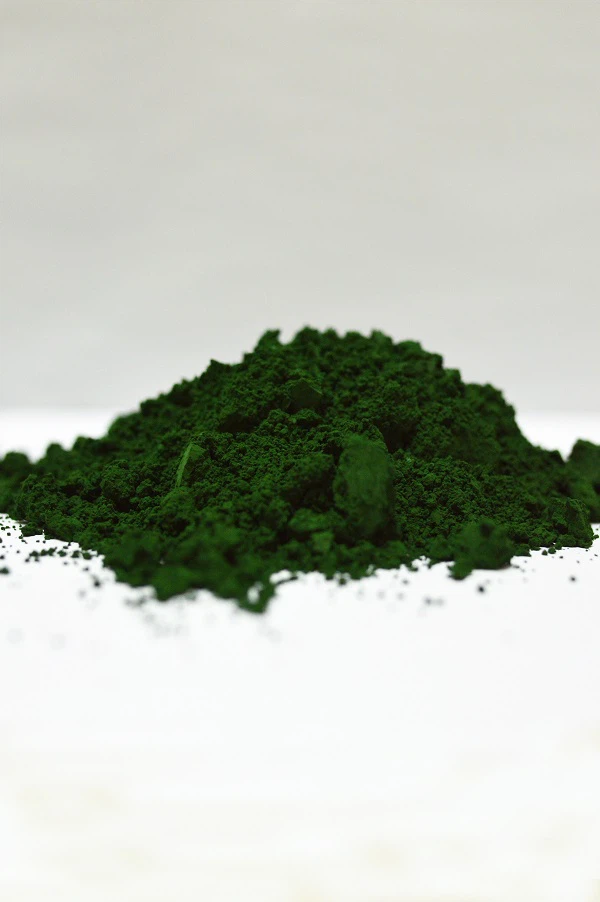


Enamel Pigments Green P.G.17 (77288)
FULLN CHEMICAL enamel pigment Green FU-E412 P.G.17 (77288)is a kind of green inorganic enamel pigment obtained by mixing, calcination and micropowder treatment of raw materials such as chromium green and alumina.
Features

FULLN CHEMICAL enamel pigment Green FU-E412, P.G. 17 (77288), is a kind of green inorganic enamel pigment obtained by mixing, calcination and micropowder treatment of raw materials such as chromium green and alumina. It's suitable for enamel products.
FU-E412 Green, pigment green 17 (77288). It has the characteristics of high temperature resistance, sun fast, UV resistance, weather resistance, acid and alkali resistance, corrosion resistance, easy dispersion, strong coloring power, covering strong, non-migration, non-penetrating color, non-toxic and so on.


|
CODE NO. |
COLOR NAME |
COLOR |
COMPONENTS |
Firing Temperature |
CAS CODE |
DESCRIPTION |
|
ENAMEL COLORS |
||||||
|
FU-E412 |
Green |
Cr-Al |
300-1250°C |
Suitable for enamel glazes. |

This series of enamel pigment Green pigments are specially developed for enamel products. We choose environmental protection, superior pure raw materials. With the strict control the process flow, we make strict detection of the pigment products on the fineness, moisture, coloring, dispersion and other parameters. So that each batch of enamel pigment products have excellent coloring performance and chemical stability. Our enamel pigment Green products are with 400 mesh sieve fineness≤0.3%, moisture≤0.5%. Our enamel pigment products have a variety of colors, including black, red, yellow, blue, purple and green. Our technical engineers can also work out the colors needed by customers according to their requirements.

Application:
Enamel products.
Suitable for ceramic and enamel coloring, rubber coloring, preparation of high temperature coatings, fine art pigments, inks, camouflage paints, etc.

Something about enamel products
Production process of Enamel products
Enamel production mainly includes preparation of glaze, preparation of blank system, coating, drying, firing, inspection and other procedures. For artistic enamel, daily enamel, sanitary enamel, architectural enamel, etc., for external decoration and use, it shall also be decorated and assembled. Industrial enamel equipment needs to be tested before assembly.

The underglaze is applied on the metal billet that is pre-pressed or cast, and then the underglaze is applied again after firing (once or several times), which is the traditional multiple coating method. The underglaze is the transition layer which is combined with the metal billet, which has strong denseness. The overglaze is applied to the underglaze, which covers the underglaze and endows the product with smooth and beautiful surface and a series of excellent physical and chemical properties. The glaze has opaque glaze (white and colored) and colorless transparent glaze. The latter is the outermost layer of the product to enhance the gloss or improve the performance of the supplementary glaze. There has been a new process of enamel coating, that is, a glaze is prepared for both the underglaze and the overglaze, which is coated and fired once to obtain the product.

Preparation of Enamel products
Vitreous glaze is a vitreous silicate or borosilicate coating on a metal body. Enamel consists of seven components, each of which has a different function. Matrix agents are the main ones, most of which are silicate, boron oxide, alumina and alkali oxide. The chemical composition of enamel is determined according to the type of material and the performance of products. Request accurately weighing, blending fully (dry mixing, also can add 5 to 15% of the water, and made into balls), the pool kiln multi-purpose furnace muffle pool (China), the crucible kiln or melting of a certain degree of uniformity in the rotary kiln, the water quenching, air-cooled or hot pressed into thin slices (0.6 ~ 1.5 mm), and then grinding (with ball mill or airflow pulverizer) into dry enamel powder or adding water slurries.

Coating of Enamel products
Apply glaze powder or glaze slurry evenly on the metal blank, and then apply glaze after firing. The enameling methods include dipping, pouring, spraying and powder spraying. Powder spreading is to sprinkle dry glaze powder over the hot bottom glaze, so as to coat and bake together as an operation. It is also a necessary method for cast iron large pieces (bathtub, reaction pot, etc.). In addition, there are electrostatic powder coating and electrophoresis coating.

Enamel Products to fired
The enamelled blank is fired in a box, turntable or tunnel furnace. The firing temperature of borosilicate bottom glaze containing dense agent is about 880 ~ 930℃. In order to make it form iron oxide layer on the surface of the blank body, which is conducive to the porcelain layer being closely packed with the blank body (steel), the oxidizing atmosphere must be adopted. The surface glaze firing temperature is slightly lower. The antimony opacite glaze is 850 ~ 900℃, and the titanium glaze is 820 ~ 860℃. In order to make the surface glaze have good opacities and bright colors, and closely combined with the bottom glaze, it is necessary to strictly control the firing time and atmosphere in the furnace.
Hot Tags: Enamel Pigments Green P.G.17 (77288), China, manufacturers, suppliers, factory, custom, wholesale, bulk, in stock, Enamel Pigments Green, Enamel Colors Black, Enamel Colors Green, Enamel Pigments Black, Enamel Colors Coffee Brown, Enamel Pigments Brown
You Might Also Like
 Learn More
Enamel Pigments Zinc Iron Chromite Brown Spinel
 Learn More
Enamel Pigments P. G. 26 Cobalt Chromium Blue Green
 Learn More
Enamel Stains Cadmium Zinc Sulfide Yellow P.Y.35
 Learn More
Enamel Pigments Yellow
 Learn More
Enamel Pigments Peacock-Green pigment P.G.26
 Learn More
Enamel Colors Green C.I. Pigment Green 50 (77377)
Send Inquiry
