


Development of peacock green in China
Appearance characteristics of malachite green glaze
The malachite green glaze fired in Jingdezhen in Qing Dynasty reached the highest level in history. It had three important features in appearance. The first important feature was that the glaze color was green and bright, which was very rare in ancient Chinese ceramic glaze.There are many kinds of green glaze colors which were colored by copper in ancient China. For example, sancai in Tang Dynasty, qionglai kiln and the green glaze colors in Changsha kiln are different in color.Some malachite green glaze green has a blue color, which is called "malachite blue" by some people. It is generally believed that blue is the function of cobalt. The results of chemical analysis show that most malachite blue has nothing to do with cobalt.The second important characteristic is that the glaze layer is clear, with few bubbles, crystal analysis and unmelted glaze materials, such as the Qing Kangxi malachite green glaze plum vase with cover, which was exhibited in the Temporary Tower exhibition. The third important feature is the glaze densely covered fish grain size of the fine open piece, very characteristic.
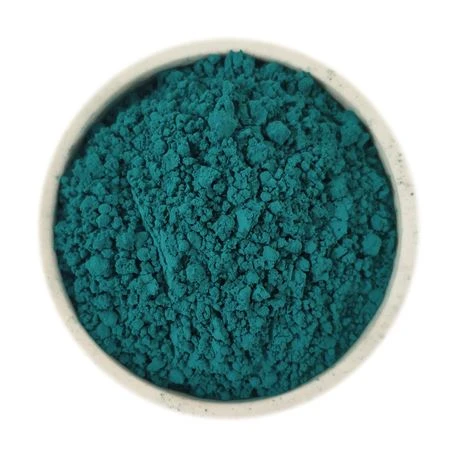
Effect of chemical composition on glaze color
Research the ancient ceramic scholars all know, ceramic glaze color is associated with many process factors, first is the type and concentration of colorant, followed by sintering atmosphere, sintering temperature and glaze layer thickness, the flux of the chemical composition of hair color also has a great influence of the colorant, China malachite green glaze of green bright glaze color in addition to related to formula contains a lot of copper (ii), and also a lot of potassium ions are closely related. Malachite green glaze in the qing dynasty is a kind of China's with nitrate and quartz sand high k content in high alkali glaze, if the use of lead oxide, feldspar, plant ash or other flux instead of nitrate, the other conditions are the same, no matter how to burn less of the malachite green hues, changsha kiln and qionglai kiln green glaze color is the best example, although they are also of copper (ii) coloring, but because they are not high alkali glaze, but also contains a small amount of opacifying agent SnO2 and P2O5, so can't burn out the malachite green hues. Malachite green glazes from Persia and Iraq have a low K2O content but a high Na2O content. Both K2O and Na2O belong to alkali metal oxides, and their chemical properties and molecular structure are quite similar, so their effect on glaze color is similar. K2O is a strong flux. If the dosage is very high and the firing temperature is high, the high-temperature viscosity of the glaze will become very low. In this case, the bubbles in the glaze layer will all run away, and the granular glaze such as quartz will all melt into the glaze, making the glaze fully vitrified. The complete vitrification of the glaze, coupled with the presence of a large number of divalent copper ions and the white enamel foil, results in a green glaze, clear and bright glaze layer, as jade, very lovely. The main colorant of malachite green glaze is copper, and the copper content is very high. For example, the malachite green glaze in The Song Dynasty is 5.6% in The Cizhou kiln, the Ming Dynasty is 3.4-5.2% in the falachite color, and the malachite green glaze in the Qing Dynasty is 9.0% in the Persian pottery unearthed in Yangzhou is 2.5-3.7%. The high copper content helps to make the glaze greener. The malachite green glaze in ancient China also contains a small amount of Fe2O3, but the content is less than 1%, which has little influence on the glaze color. The malachite green glaze fired in the north before the Qing Dynasty also contained a large amount of lead and a small amount of opacite SnO2. Chemical analysis results show that the presence of the SnO2 associated with copper, in the qing dynasty before the malachite green glaze, if the glaze in the copper content is higher, generally have a tin, and vice versa, it shows that the tin is likely to be the use of copper oxide slag during smelting bronze skin as ingredients in with not intentionally added, bronze is copper tin lead alloy, when the qing dynasty as the bronze production have been replaced by brass and red copper, brass and copper smelting slag produced in the skin are mainly copper oxide, not including tin, so the results of chemical analysis found no tin. As mentioned earlier, malachite green glazes are sometimes slightly blue, which is generally believed to be caused by cobalt oxide. However, the results of chemical analysis showed that, except for a few purple and blue gaoler fired in the early north, which contained about 0.6% CoO, most of the malachite blue contained no cobalt, and the purple and blue Gaoler fired in the early north contained a small amount of MnO in addition to CoO, which was caused by the use of cobalt as CoO source. Malachite green glaze belongs to divalent copper ion coloring, must be fired in an oxide flame, the firing temperature is 950~1000℃.


